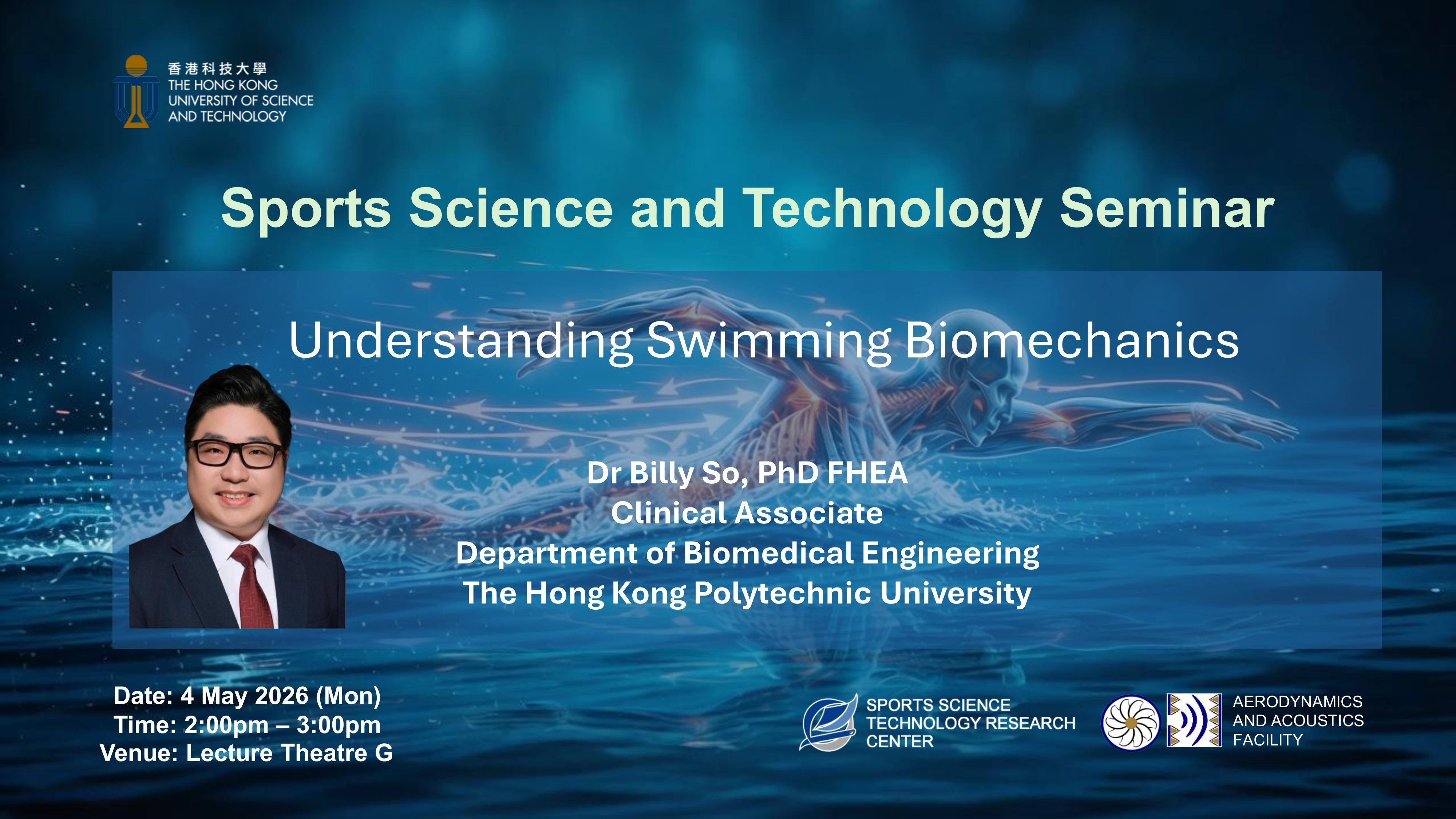
Understanding Swimming Biomechanics

Speaker's Bios
Dr. Billy So is the Clinical Associate in the Department of Biomedical Engineering at The Hong Kong Polytechnic University, where he is also affiliated with the Research Institute for Sports Science and Technology. A registered physiotherapist by training, his research spans biomechanics, sports medicine, aquatic physiotherapy, ergonomics, and rehabilitation technology. His recent work has focused particularly on swimming biomechanics and the application of video analytic systems, wearable sensors, and AI-enabled tools for performance monitoring and injury prevention. Dr. So has authored over 50 peer-reviewed publications and has secured competitive funding for projects related to aquatic rehabilitation, swimming performance enhancement, and sports technology. He is the Founding Coordinator of the AI SwimTech Laboratory at PolyU.
Abstract
Swimming performance emerges from the dynamic interaction between the athlete and the aquatic environment, where propulsion, drag, body alignment, and coordination collectively determine movement efficiency. This seminar presents an overview of the biomechanical principles underlying swimming, with emphasis on how swimmers generate effective propulsion, reduce hydrodynamic resistance, and optimize stroke. Key determinants of performance, including technique, strength, and inter-limb coordination, will be discussed from a biomechanical perspective.
The seminar will also address how biomechanical analysis can contribute to injury prevention and long-term athlete development. By integrating biomechanical theory with practical examples of video analytics and wearable sensing, this seminar aims to demonstrate how emerging technologies can enhance swimming performance monitoring and inform more precise training strategies.